VISITAS RECIENTES

AUTISMO TEA PDF

AUTISMO TEA PDF
TRASTORNO ESPECTRO AUTISMO y URGENCIAS PDF

We Support The Free Share of the Medical Information

Enlaces PDF por Temas

Nota Importante

Aunque pueda contener afirmaciones, datos o apuntes procedentes de instituciones o profesionales sanitarios, la información contenida en el blog EMS Solutions International está editada y elaborada por profesionales de la salud. Recomendamos al lector que cualquier duda relacionada con la salud sea consultada con un profesional del ámbito sanitario. by Dr. Ramon REYES, MD

Niveles de Alerta Antiterrorista en España. Nivel Actual 4 de 5.

Niveles de Alerta Antiterrorista en España. Nivel Actual 4 de 5.
Fuente Ministerio de Interior de España

sábado, 27 de abril de 2019

Medical tourism: Are the savings worth the risks? Christopher Elliott, Special to USA TODAY

Medical tourism: Are the savings worth the risks? Christopher Elliott, Special to USA TODAY 


More people than ever are flying after surgery, thanks to the increased popularity of medical tourism. MedAire shares some tips on flying after surgery with USA Today.
hashtagmedicaltourism hashtagflying hashtagairlines 

Published 12:00 p.m. ET April 26, 2019


Bill and Eleanor Seavey run a small inn near Hearst Castle in California, but when they go on vacation, they head south. In a few weeks, they're planning to visit Los Algodones, Mexico, just across the border from Yuma, Arizona, for some sun – and dental work.

"Many of their dentists are trained in the U.S.," says Bill Seavey. "We can get work done for about one-third of the U.S. prices. Our local dentist actually recommended we go there."

Los Algodones, also known as "Molar City," is a small town in northern Baja California that caters to American and Canadian tourists trying to escape the high cost of medical care. As an added benefit, Yuma also holds the record for being the sunniest place in America.

Combining a vacation with a medical procedure is becoming more popular. A new study by Wise Guy Reports, a market research company, predicts the worldwide medical tourism market will grow from $56 billion in 2018 to $136 billion in 2023, a growth rate of 19% a year.

Here's what you need to know about medical tourism: There's a time to follow the Seaveys south and a time to stay closer to home. That's because you don't want to cut corners on some procedures.

The risks are real
There are real risks to combining a vacation and a medical visit. Consider the recent investigation of a Miami plastic surgery clinic by USA TODAY and the Naples Daily News. It found a clinic run like a factory assembly line, where poorly trained doctors line up patients and operate on as many as eight a day. In the past six years, the clinic and a nearby facility overseen by the same doctor have lost eight patients.


More: This business helped transform Miami into a national plastic surgery destination. Eight women died.

That's why it's so important to carefully screen any doctor or facility you're considering. "I would urge anyone thinking about medical tourism for surgery to be very careful," says Joshua Zuckerman, a New York plastic surgeon. "I would suggest patients seek countries with high-quality medical systems, training and technology, but I have even taken care of patients with serious complications from surgery undertaken in European countries. Cosmetic surgery is still significant surgery and requires specialized training to be performed safely."

It's not enough to find a doctor with positive reviews on social media. Look for board certifications that show your medical practitioner is a real expert. Also, check the state's medical board website to find out if your physician is in good standing (here's California's site, for example).

You don't want to cut corners on some medical procedures.
You don't want to cut corners on some medical procedures. (Photo: Getty Images)

When to go
Some destinations are worth considering for medical tourism, according to the editors at International Living magazine, a publication for American expatriates. Take Costa Rica, for example, a country that abolished its army and dedicated part of the money to healthcare. Now nearly 15% of international tourism comes to visit Costa Rica for medical services performed by highly trained, bilingual doctors.

"Most of the top plastic surgeons are located in the medical centers in or near the capital of San Jose, where medical tourists save 45% to 65% on procedures compared to back home," says Kathleen Evans, International Living's Coastal Costa Rica correspondent.

You can even save money on procedures such as LASIK surgery. In Costa Rica, she says prices range from $1,600 to $2,000 – for both eyes. "The licensed eye surgeons who perform LASIK in Costa Rica receive the same level of ophthalmology schooling as in North America and are using the same state-of-of-the-art, high-tech equipment that you would find back home,” she adds.

The conventional wisdom seems to be that if your procedure is relatively simple and the doctor checks out, you might want to consider becoming a medical tourist.

And when to stay
Sometimes you'll want to stay in the country. That's what I discovered when I sought treatment for my vision problems recently. I had a complicated prescription and suffered from splitting headaches.

I consulted with some of the best eye surgeons in the western United States. Their diagnosis wasn't hopeful. Since I'd already had LASIK in both eyes back in 2008, they were reluctant to operate again. All of them recommended just living with my current vision – except one.

That doctor happened to be based in Southern California. So in January, I rented an apartment in Studio City and took an Uber to his clinic, where he performed a procedure called photorefractive keratectomy (PRK) to fix my vision. Needless to say, this is not how you save money as a medical tourist.

But you can't argue with the results. I'm looking at my computer screen without glasses.

And that's the thing about medical tourism. Sometimes, you'll want to go to Molar City to have your teeth cleaned. And sometimes, you'll want to fly to Los Angeles to get your eyes fixed. It's not about your money – it's about your health.

Tips on flying after surgery
MedAire, a company that provides medical support to airlines, says more people than ever are flying after surgery, thanks to the increased popularity of medical tourism. Some of them are long-haul flights. For example, many people are traveling to India for highly complex medical procedures such as open-heart surgeries and pacemaker or cardioverter defibrillator implants. Amman, Jordan, is becoming a center of referral for laparoscopic bariatric surgeries and procedures. Once your doctor clears you for travel, here are a few tips on flying after surgery.

• Don't forget your paperwork. Contact the airline before the flight and request a medical information form. The MEDIF is often available on the airline’s website. Airline policies on fitness to fly vary, so research yours. Have a note from your doctor clearing you for travel by air.

• Mind the trapped gas. Surgery leaves some residual air inside the body. Any trapped gas in the body will expand at in-flight altitude, which can cause mild to severe discomfort and can even be life-threatening.

• Remember, there's less oxygen. Medical conditions sensitive to hypoxia, such as some pulmonary and cardiovascular diseases, could deteriorate in flight because of reduced oxygen pressure. That's also true for anemias, which also can occur following a surgery or medical procedure.

Christopher Elliott is a consumer advocate. Contact him at chris@elliott.org or visit elliott.org.

miércoles, 17 de abril de 2019

WHO guideline recommendations on digital interventions for health system strengthening free PDF

WHO guideline recommendations on digital interventions for health system strengthening free PDF 

Publication details

Number of pages124
Publication date2019
LanguagesEnglish
ISBN978-92-4-155050-5

DOWNLOAD

The key aim of this guideline is to present recommendations based on a critical evaluation of the evidence on emerging digital health interventions that are contributing to health system improvements, based on an assessment of the benefits, harms, acceptability, feasibility, resource use and equity considerations. For the purposes of this version of the guideline, the recommendations examine the extent to which digital health interventions available via mobile devices are able to address health system challenges at different layers of coverage along the pathway to universal health coverage (UHC). By reviewing the evidence of different digital interventions, as well as assessing the risks against comparative options, this guideline aims to equip health policy-makers and other stakeholders with recommendations and implementation considerations for making informed investments into digital health interventions.
This guideline urges readers to recognize that digital health interventions are not a substitute for functioning health systems, and that there are significant limitations to what digital health is able to address.

FEMA Incident Action Planning Guide free PDF

FEMA Incident Action Planning Guide free PDF 
DOWNLOAD


lunes, 15 de abril de 2019

Incorporating Active Shooter Incident Planning into Health Care Facility Emergency Operations Plans

Incorporating Active Shooter Incident Planning into Health Care Facility Emergency Operations Plans

DOWNLOAD 

Improving Active Shooter/ Hostile Event Response Best Practices and Recommendations for Integrating Law Enforcement, Fire, and EMS (Interagency Board, September 2015)

Fire/Emergency Medical Services Department Operational Considerations and Guide for Active Shooter and Mass Casualty Incidents FEMA

Fire/Emergency Medical Services Department Operational Considerations and Guide for Active Shooter and Mass Casualty Incidents FEMA 
DOWNLOAD

First Responder Guide for Improving Survivability in Improvised Explosive Device and/or Active Shooter Incidents / Guía DHS para mejorar la supervivencia de primeros respondientes a un incidente a dispositivo explosivo improvisado y tiroteos activos

First Responder Guide for Improving Survivability in Improvised Explosive Device and/or Active Shooter Incidents / Guía DHS para mejorar la supervivencia de primeros respondientes a un incidente de dispositivo explosivo improvisado y tiroteos activos


Link to download PDF for Free


FREE PDF: First Responder Guide for Improving Survivability in Improvised Explosive Device and/or Active Shooter Incidents / Guía DHS para mejorar la supervivencia de primeros respondientes a un incidente a dispositivo explosivo improvisado y tiroteos activos 
Bajar en el enlace http://goo.gl/L7J3LR

Cortesía
EMS España / Emergency Medical Services en España
Follow me / INVITA A TUS AMIGOS A SEGUIRNOS
https://www.facebook.com/drramonreyesdiaz/


Handbook for EMS Medical Directors by FEMA 2012 pdf

Handbook for EMS Medical Directors by FEMA 2012 pdf 

DOWNLOAD


UNTIL THE HELP ARRIVE instructor guide Version 2.0 by FEMA Uniformed Services University PPT and PDf

https://www.fema.gov/media-library/assets/documents/167623


Until Help Arrives 


for the Until Help Arrives course, designed to teach students basic skills to keep people with life-threatening injuries alive until professional help arrives.


Tactical Emergency Medical Support (TEMS) Protocols Prehospital Emergency Care Protocols Homeland Security free Pdf

Tactical Emergency Medical Support (TEMS) Protocols Prehospital Emergency Care Protocols Homeland Security free Pdf


Link to DOWNLOAD

jueves, 11 de abril de 2019

The LTP (Lateral Trauma Position) Why Should You Put Some Trauma Patients on Their Side?

The LTP (Lateral Trauma Position)  Why Should You Put Some Trauma Patients on Their Side?

The LTP (Lateral Trauma Position)
2015 New Hampshire EMS Protocol 4.5 – Spinal Trauma says, “Patients with nausea or vomiting may be placed in a lateral recumbent position. Maintain neutral head position with manual stabilization, padding/pillows, and/or patient’s arm.” The protocol cited above gives us the option to put a patient on their side while maintaining neutral head position in a situation involving nausea or vomiting.
One of the technique is the Norwegian Lateral Trauma Position (LTP). The goal is to transport a trauma patient who is at risk for airway compromise on their side while making reasonable attempts to maintain inline stabilization of the spine and minimize movement.
Don’t do things without authorization from protocols, medical direction, administration – and you know, the legal stuff.
Why Should You Put Some Trauma Patients on Their Side?

Our practice in EMS for decades has been to strap trauma patients to a rigid longboard in a supine position. This has been thought to protect the spine from further injury. We’ve all gotten pretty good at performing that technique, so we’re comfortable doing it.
Unfortunately that comfort is not shared by the patient. Being secured to a ongboard is not comfortable, it’s painful, and it can cause harm to the patient. Furthermore, there is no evidence that it actually makes a difference in patient outcome. So numerous EMS leaders are creating a sea change in EMS across the USA to stop using rigid longboards in the transport of trauma patients.


In 2014-2015 statewide protocols in several New England states took longboards out of the routine care for patients with potential or actual spine trauma. Anecdotal evidence to this point looks very good. However, did we give up anything useful by stopping the practice of transporting patients strapped to a backboard? Let’s think about airway management for a minute. Picture this, you’re in the back of the ambulance with a patient on a backboard. The patient starts to vomit. A lot. How did you manage that? Your suction device wasn’t going to help in this scenario, so as quickly as you could you undid the straps and rolled the patient and backboard up on its side. Gravity then saved the day.

Same scenario, but now we’re NOT transporting the patient on the backboard. How can you roll this patient up on their side and still maintain alignment of the spine? You probably can’t. However airway and breathing come before disability so you do the best you can.
Our state protocols recognize this potential scenario, and say if you think your patient is at risk for vomiting, you should transport them on their side. The language from the 2015 New Hampshire EMS Protocol 4.5 – Spinal Trauma says, “Patients with nausea or vomiting may be placed in a lateral recumbent position. Maintain neutral head position with manual stabilization, padding/pillows, and/or patient’s arm.”


But, but, but, I can’t do that… a trauma patient HAS to be transported supine. Right?
Dogma is defined by the Merriam-Webster dictionary as “a belief or set of beliefs that is accepted by the members of a group without being questioned or doubted”. Maybe the paradigm of transporting every trauma patient in a supine position is dogma that needs to be reconsidered.
The protocol cited above gives us the option to put a patient on their side while maintaining neutral head position in a situation involving nausea or vomiting. This means proactively doing so before initiating transport. THIS IS A VERY GOOD IDEA. There are clearly patients that you can anticipate that vomiting may be in their near future, and you should proactively take steps to deal with it. If endotracheal intubation with RSI, is in your scope of practice that may be the path you take, but transporting the patient on their side may be just as effective and certainly less invasive.
So again, putting a trauma patient who is at risk for aspiration on their side for transport rather than transporting them supine is a very good idea. However we need to do this in a manner that still maintains an inline stabilization of the spine. How do you do that? Good question.
That’s the challenge this project seeks to address. We would like to have a technique that can accomplish that objective.

The Norwegian Lateral Trauma Position


Fortunately our EMS colleagues in Norway developed and have been utilizing a technique called the Lateral Trauma Position for over a decade, with success. What we seek to do here at the LateralTraumaPosition.org project is to take what the Norwegian EMS system started, and help our EMS colleagues in the USA develop this skill. We hope to provide you with information that can help you form your own clinical opinion and your own clinical practice.
This website includes a video that was produced by EMS providers in Norway illustrating the lateral trauma position (LTP) as they practice it. We’ve also included research studies that attempt to determine the effectiveness and safety of the technique. We believe that our practice in EMS should be based on evidence when possible. The current evidence on the LTP isn’t that strong, no randomized controlled trials. But the evidence is growing. This is thanks to the leadership of Dr. Per Kristian Hyldmo, a flight physician for the helicopter EMS system in Norway. We highly admire his work and hope to follow in his footsteps.
The demonstration videos in this website show the LTP as we have worked out the bugs for us. We wouldn’t presume to say this is the only way to do it. What we do say is that EMS providers need to practice a technique that accomplishes the goal, which is to transport a trauma patient who is at risk for airway compromise on their side while making reasonable attempts to maintain inline stabilization of the spine and minimize movement.
We suggest your team starts with our techniques, modifies the techniques to what works for you, then practice it. A lot.
Listen, for years and years we practiced the PHTLS technique of a standing takedown onto a long backboard, right? Well our evolving practice appears to be doing away with that technique, but we should practice the new LTP technique with the same fervor.
So we ask you to review our “how to” videos, practice them with your crews, modify them to suit your needs and your equipment, and get really good at it. We’d really appreciate your feedback and your modifications of the techniques, including photos and videos.
Finally, understand that we’re not holding ourselves out as experts on the topic of spinal immobilization. We are not researchers. We are simply partners in trying to develop an effective technique in the setting of changing protocols and clinical practices.
Oh, and don’t do things without authorization from protocols, medical direction, administration – you know, the legal stuff.
Be safe,
The LateralTraumaPosition.org Team

Daños de un atropeyo segun la velocidad. Infografia

Daños de un atropeyo segun la velocidad. Infografia
NO SOLO EN SEMANA SANTA DEBES DE SER UN BUEN CONDUCTOR

Ley No. 63-17, de Movilidad, Transporte Terrestre, Tránsito y Seguridad Vial de la República Dominicana. G. O. No. 10875 del 24 de febrero de 2017.

https://emssolutionsint.blogspot.com/2019/01/ley-no-63-17-de-movilidad-transporte.html


SUBITUS International 
 @SUBITUSINT #SUBITUSINT 
+1 849-849-8576 
+34 671454059 

sábado, 6 de abril de 2019

MODELO DE PLAN DE CONTINGENCIA Para Estados Municipios y Delegaciones pdf Gratis 

Enlace para DESCARGAR


SUBITUS International 
 @SUBITUSINT #SUBITUSINT 
+1 849-849-8576 
+34 671454059 

Guía para la elaboración de Programas de Protección Civil y Planes de Contingencias. Para Estados, Municipios y Delegaciones. MEXICO pdf Gratis

Guía para la elaboración de Programas de Protección Civil y Planes de Contingencias. Para Estados, Municipios y Delegaciones. MEXICO pdf Gratis

Enlace para DESCARGAR 


SUBITUS International 
 @SUBITUSINT #SUBITUSINT 
+1 849-849-8576 
+34 671454059 

martes, 2 de abril de 2019

The European guideline on management of major bleeding and coagulopathy following trauma: fifth edition 2019 FREE pdf

The European guideline on management of major bleeding and coagulopathy following trauma: fifth edition 2019 FREE pdf 

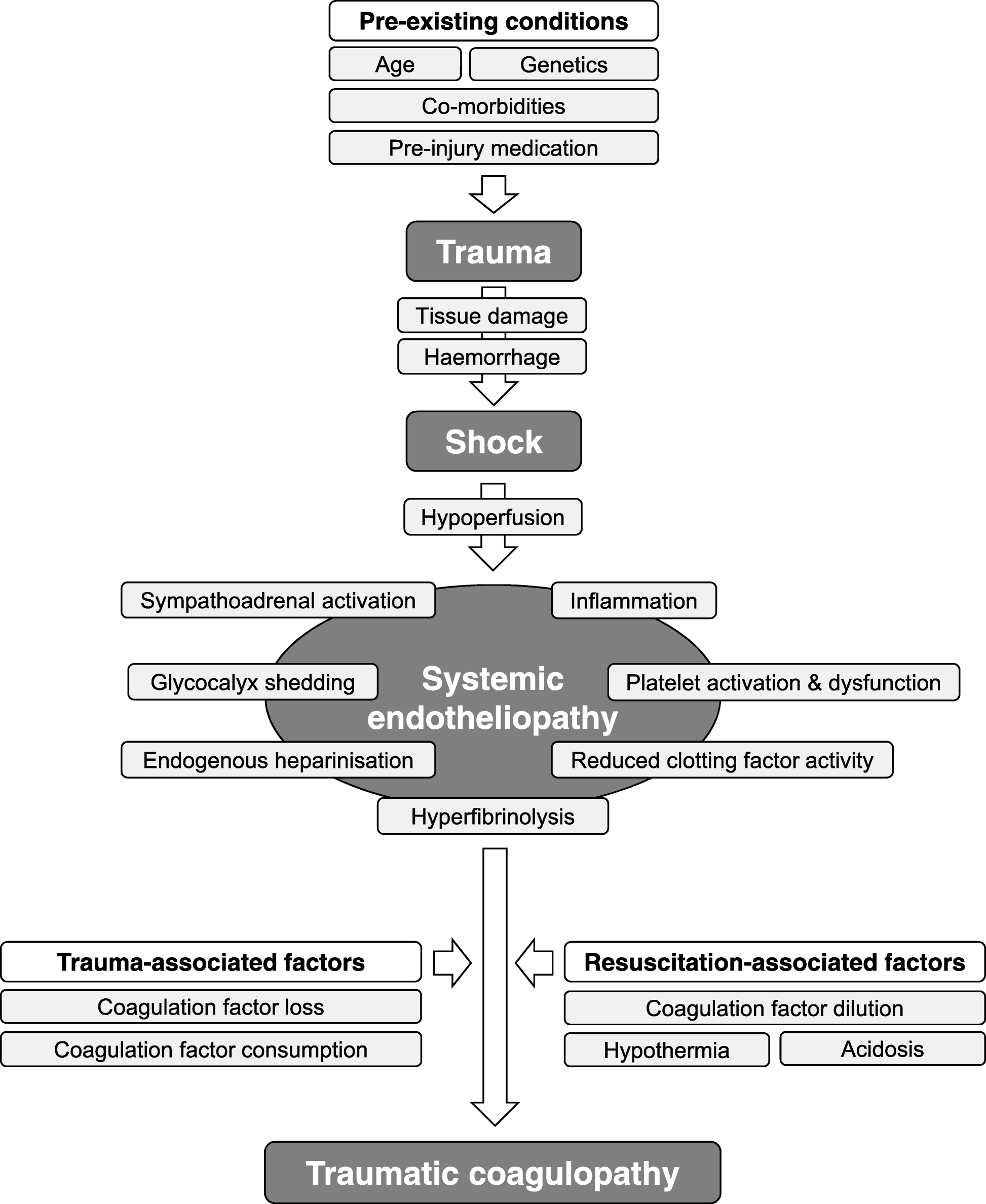
The appropriate management of trauma patients with massive bleeding and coagulopathy remains a major challenge in routine clinical practice. A multidisciplinary approach and adherence to evidence-based guidance are key to improving patient outcomes, which could now be shown in the first outcome studies.

DOWNLOAD free pdf 

read full articule 


Check if is updated

https://media.springernature.com/full/springer-static/image/art%3A10.1186%2Fs13054-019-2347-3/MediaObjects/13054_2019_2347_Fig1_HTML.png

Fig. 2
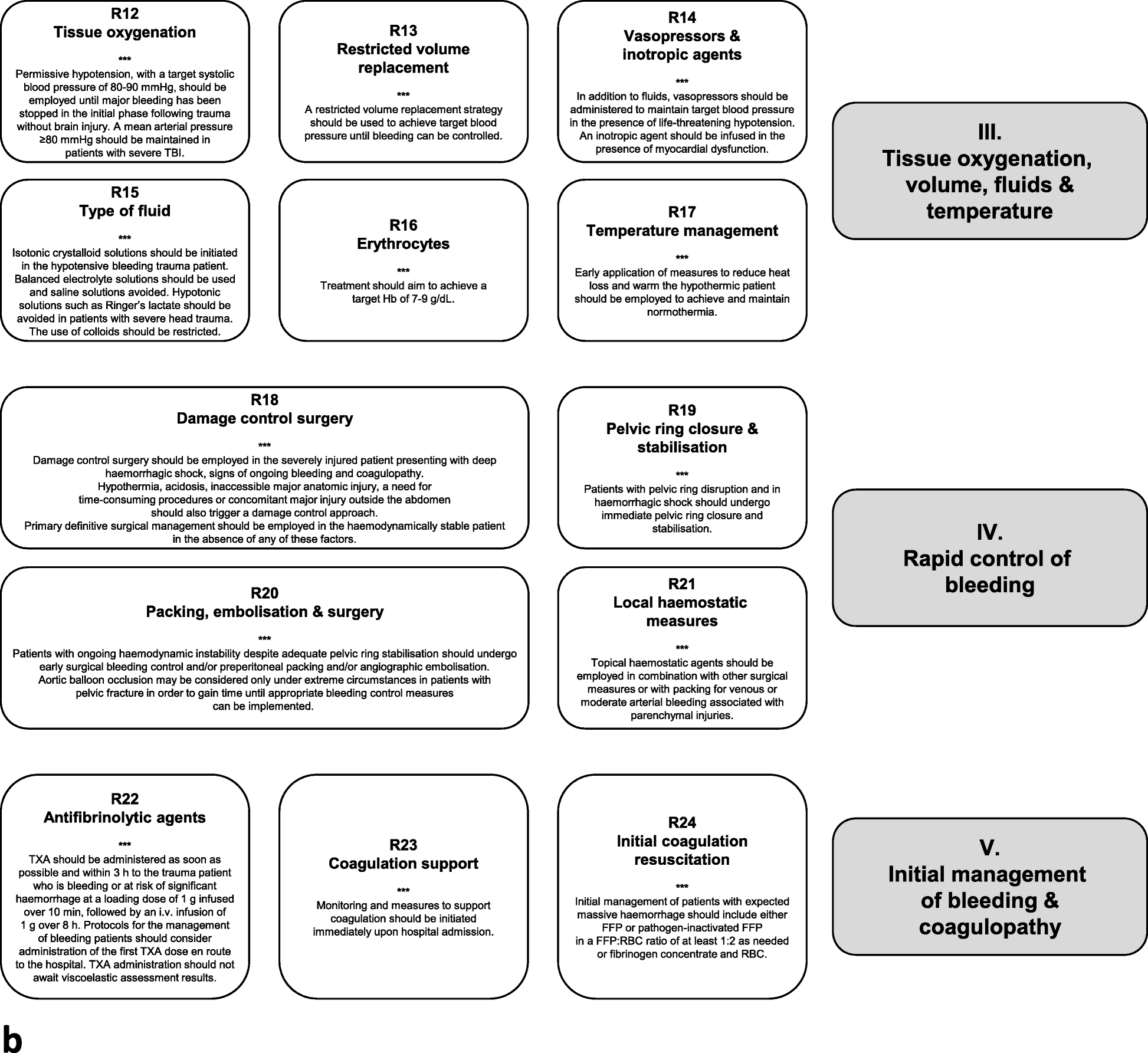
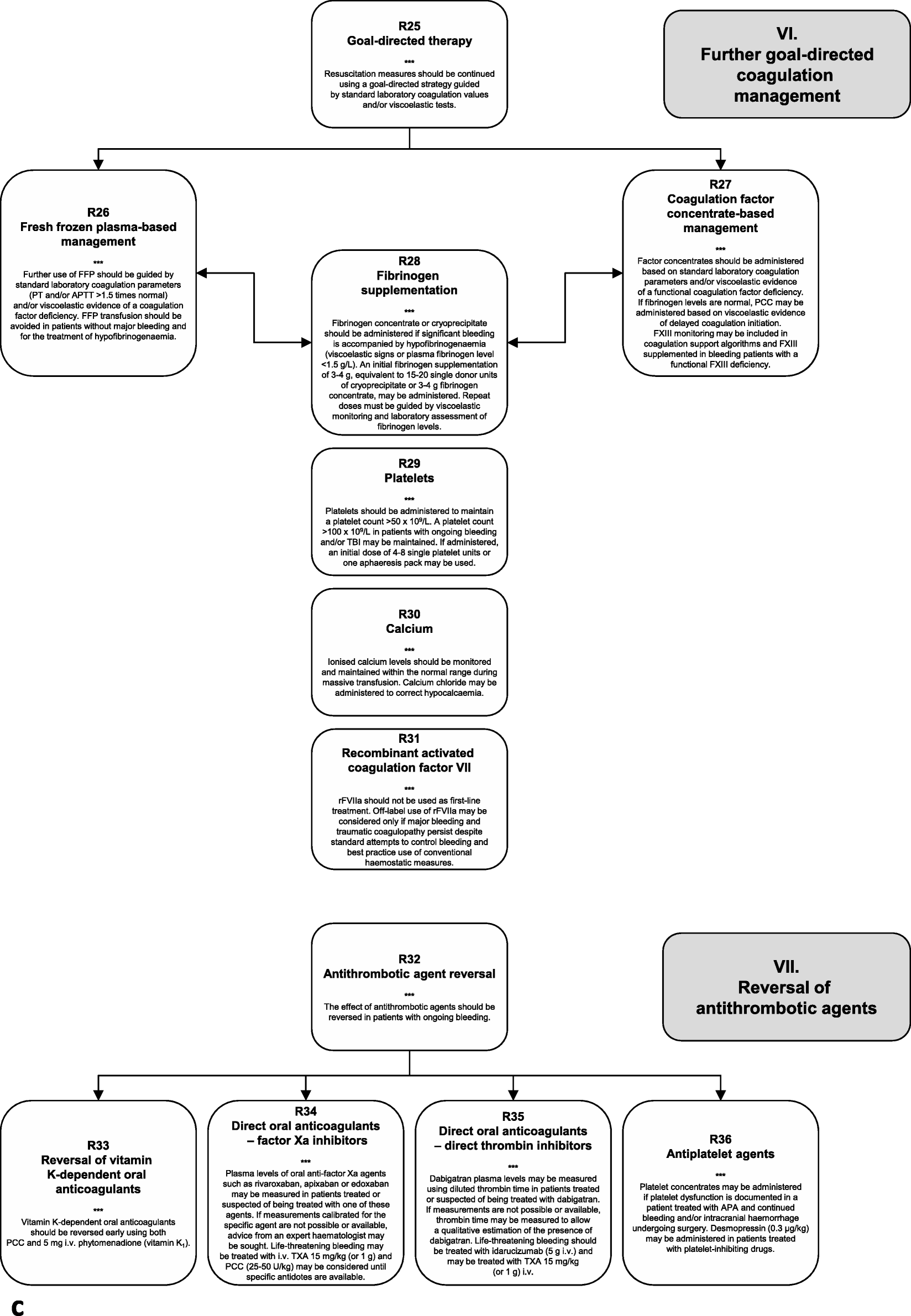
a Summary of treatment modalities for the bleeding trauma patients included in this guideline. CT, computed tomography; FAST, focused assessment with sonography in trauma; Hb, haemoglobin; PT, prothrombin time. b Summary of treatment modalities for the bleeding trauma patients included in this guideline. FFP, fresh frozen plasma; Hb, haemoglobin; RBC, red blood cells; TBI, traumatic brain injury; TXA, tranexamic acid. cSummary of treatment modalities for the bleeding trauma patients included in this guideline. APA, antiplatelet agent; APTT, activated partial thromboplastin time; FFP, fresh frozen plasma; FXIII, factor XIII; PCC, prothrombin complex concentrate; PT, prothrombin time; rFVIIa, recombinant activated coagulation factor VII; TBI, traumatic brain injury; TXA, tranexamic acid

https://media.springernature.com/full/springer-static/image/art%3A10.1186%2Fs13054-019-2347-3/MediaObjects/13054_2019_2347_Fig2a_HTML.png

https://media.springernature.com/full/springer-static/image/art%3A10.1186%2Fs13054-019-2347-3/MediaObjects/13054_2019_2347_Fig2b_HTML.png

https://media.springernature.com/full/springer-static/image/art%3A10.1186%2Fs13054-019-2347-3/MediaObjects/13054_2019_2347_Fig2c_HTML.png


SUBITUS International 
 @SUBITUSINT #SUBITUSINT 
+1 849-849-8576 
+34 671454059