VISITAS RECIENTES

AUTISMO TEA PDF

AUTISMO TEA PDF
TRASTORNO ESPECTRO AUTISMO y URGENCIAS PDF

We Support The Free Share of the Medical Information

Enlaces PDF por Temas

Nota Importante

Aunque pueda contener afirmaciones, datos o apuntes procedentes de instituciones o profesionales sanitarios, la información contenida en el blog EMS Solutions International está editada y elaborada por profesionales de la salud. Recomendamos al lector que cualquier duda relacionada con la salud sea consultada con un profesional del ámbito sanitario. by Dr. Ramon REYES, MD

Niveles de Alerta Antiterrorista en España. Nivel Actual 4 de 5.

Niveles de Alerta Antiterrorista en España. Nivel Actual 4 de 5.
Fuente Ministerio de Interior de España

domingo, 23 de junio de 2024

Julio Verne

EL MISTERIO DE JULIO VERNE

Verne predijo algo parecido a internet en una obra inédita hasta finales del siglo XX (“París en el siglo XX”). Y no fue publicada en su época a causa de su concepción catastrófica de la vida y la sociedad, curiosamente, muy similar a la actual. Verne también imaginó la televisión y el helicóptero, así como la subida al poder del Nacional socialismo en la figura de Hitler. El primer submarino fue otra de sus fantasías hechas realidad. El maravilloso Nautilus de “20.000 leguas de viaje submarino” no sólo deslumbró a los lectores por su originalidad, sino también por la autosuficiencia del aparato que permitía vivir en el mar sin tocar tierra firme.

Sin embargo, son sus obras “De la Tierra a la Luna” y “Alrededor de la Luna”, las que han cimentado la fama profética de Verne. En ellas el escritor brinda detalles precisos que, posteriormente, dejaron pasmados a los expertos cuando el hombre puso por primera vez el pie en la Luna. En esas novelas Verne eligió a Estados Unidos como país financiador del proyecto y al estado de Florida para el lanzamiento; un lugar muy próximo a Cabo Cañaveral. Y aún más: en la novela, el aterrizaje también se produce en el mar, a escasas cuatro millas del lugar en el que amarizó el Apolo 11. Tanto la velocidad de la cápsula como sus dimensiones se aproximan mucho a las reales de aquel Apolo 11 tripulado, también por tres astronautas...

Todo esto demuestra que Verne fue un pozo de ciencia. Aunque también existe la creencia de que formó parte de una milenaria sociedad secreta (la masonería) y tuvo acceso a datos que muy pocos hombres conocían. Su atracción hacia la criptografía quedó plasmada en muchas de sus obras y hay quien encuentra un mundo oculto y esotérico incluso en los nombres de sus personajes.

sábado, 22 de junio de 2024

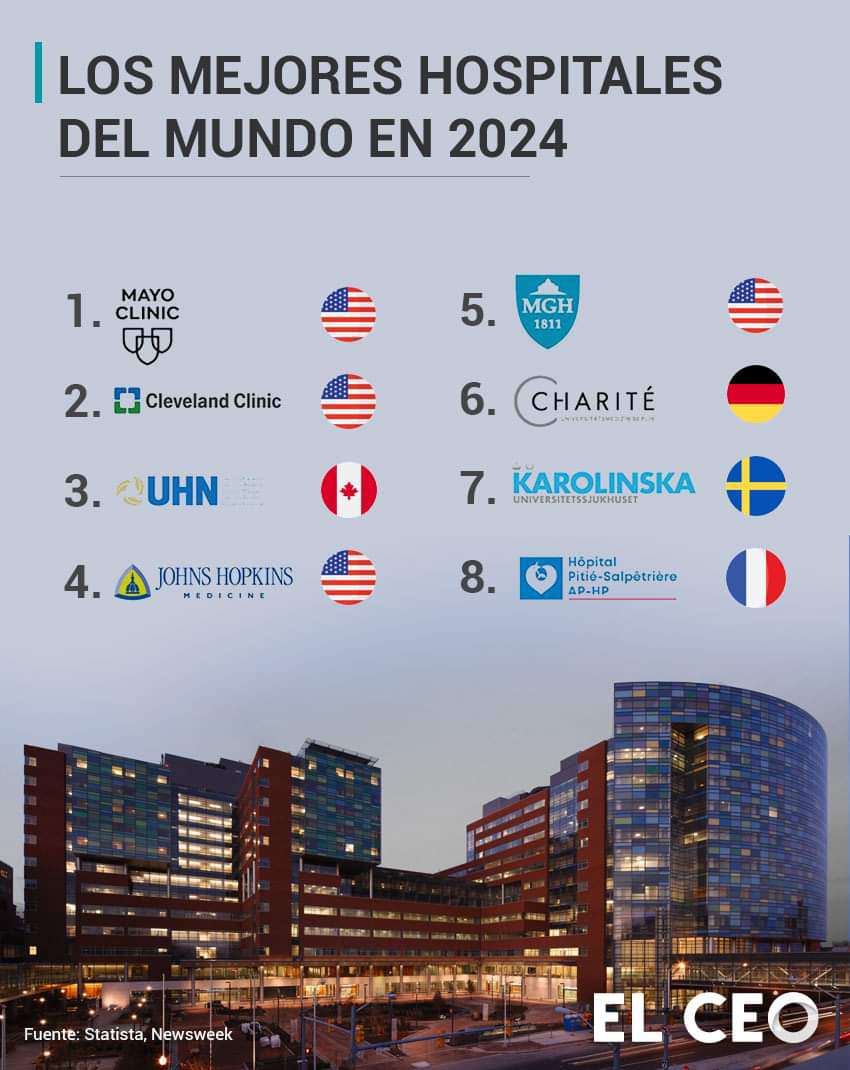
Mejores Hospitales del Mundo 2024

Cuatro de los cinco mejores hospitales del mundo están ubicados en Estados Unidos, según una clasificación conjunta de Statista y Newsweek.

El ranking se basa en una encuesta realizada a más de 85,000 profesionales médicos de 30 países, junto con investigaciones adicionales sobre encuestas a pacientes y datos de rendimiento hospitalario.

acueducto romano

🇪🇸 Enorme acueducto romano construido en Segovia, España, por el emperador Hispano Trajano (r. 98-117 d. C.).

Acueducto 
Del lat. aquaeductus, de aquae 'de agua' y ductus 'conducción'.

1. m. Conducto de agua formado por canales y caños subterráneos, o por arcos levantados.

Sin.: 
conducto, canal, conducción, aguaducho.
servidumbre de acueducto

Sinónimos o afines de acueducto
conducto, canal, conducción, aguaducho.

Real Academia Española © Todos los derechos reservados

Rifle para tirador selecto FN Herstal FN SCAR-H PR (Special Operations Forces Combat Assault Rifle-Heavy Precision Rifle) perteneciente a la Unidad de Operaciones Especiales de la Armada de México (UNOPES).

Rifle para tirador selecto FN Herstal FN SCAR-H PR (Special Operations Forces Combat Assault Rifle-Heavy Precision Rifle) perteneciente a la Unidad de Operaciones Especiales de la Armada de México (UNOPES).

Este rifle de fabricación belga emplea municiones calibre 7.62x51 mm OTAN, las cuales van alojadas dentro de un cargador de aluminio tipo M16 para 20 municiones (aunque existe uno para sólo 10). Está construido en aluminio y polímero y se le fabrica en dos colores, en negro y arena.

Se le comercializa con dos longitudes de cañón, 20 (50.8 cm) y 16 pulgadas (40.6 cm) por lo que la longitud máxima del arma es de 107 cm y 97 cm respectivamente, con la culata totalmente extendida aunque retraída y plegada a un costado mide sólo 82.3 cm y 72.1 cm respectivamente. Cuenta con culata extensible y plegable a un costado que le permite portarlo y operarlo en espacios muy reducidos como al interior de un vehículo o una aeronave, además de poderse ajustar en seis diferentes longitudes y dos en altura. Su peso sin el cargador es de sólo 4.5 kg para la versión de 20” y 4.2 kg para la 16”.

Tiene una volumen de fuego de 550 disparos por minuto y es accionada por gases con cerrojo rotativo. Su selector de disparo, palanca de carga y liberador del abastecedor son ambidiestros y el selector puede poser dos o tres posiciones dependiendo la versión, S (seguro), 1 (semiautomático) y A (automático).

Tiene rieles Picatinny en las cuatro posiciones para instalar accesorios tácticos como miras holográficas, linternas tácticas, señalador láser y agarradera frontal como el de la imagen. Sus órganos de puntería metálicos son plegables o removibles. El de la imagen posee una mira telescópica Schmidt&Bender 3-12x50 PM II de fabricación alemana y bípedo plegable.

Además de los UNOPES a los que se les ha visto también el modelo SCAR 10 CQC (Special Operations Forces Combat Assault Rifle 10" Close Quarters Combat), se ha visto a personal de la Brigada de Fusileros Paracaidistas (BFP) del Ejército Mexicano utilizar la versión FN Herstal FN SCAR-L STD (Special Operations Forces Combat Assault Rifle-Light Standard).

Otros usuarios del SCAR H en el mundo son Bélgica, Brasil, Chile, Chipre, España, Estados Unidos, Francia, India, Kenia, Lituania, Noruega, Perú, Portugal, Serbia, entre otros.

#ArmadaDeMexico #SEMAR #MexicanArmy #UNOPES #FuerzasEspeciales #SpecialForces #FNHerstal #SCAR #SCARH #SCARHPR #Fusil #Rifle #SentinelMexico

Ergonomia-postura al conducir vehículos de motor

Explicación de la postura del asiento al conducir un automóvil


 Mantener la postura de conducción correcta es esencial para la seguridad, la comodidad y la reducción del riesgo de lesiones.  A continuación se ofrece una explicación detallada de la postura óptima al sentarse al conducir un automóvil:


 1. Posicionamiento del asiento

 Altura del asiento: Ajuste la altura del asiento para que sus caderas estén al menos tan altas como sus rodillas.  Esto ayuda a reducir la presión en la zona lumbar y mejora la visibilidad.

 Distancia del asiento: Mueva el asiento hacia adelante o hacia atrás para que pueda alcanzar cómodamente los pedales con los pies.  Tus rodillas deben estar ligeramente flexionadas al presionar los pedales, asegurándote de que no necesites estirarte para alcanzarlos.

 Inclinación del asiento: Incline el asiento ligeramente hacia atrás de modo que el ángulo entre los muslos y el torso sea de aproximadamente 100 a 110 grados.  Esto ayuda a reducir la presión en la zona lumbar.

 2. Ángulo del respaldo

 Recline el respaldo: ajuste el respaldo a una posición en la que pueda sentarse con toda la espalda contra él, incluida la parte inferior.  Se recomienda un ángulo de aproximadamente 100 a 110 grados para reducir la tensión en la columna.

 Soporte lumbar: si su asiento para el automóvil tiene soporte lumbar ajustable, utilícelo para mantener la curva natural de la zona lumbar.

 3. Posición del volante

 Distancia desde el volante: ajuste el volante de modo que quede a entre 10 y 12 pulgadas de su pecho.  Sus brazos deben estar ligeramente doblados a la altura de los codos, con las manos apoyadas cómodamente en el volante en las posiciones de las 9 y las 3 en punto.

 Altura del volante: La parte superior del volante debe estar a la altura de los hombros, lo que le permitirá ver el panel de instrumentos sin tener que inclinar la cabeza.

 4. Ajuste del reposacabezas

 Altura: La parte superior del reposacabezas debe estar al mismo nivel que la parte superior de su cabeza.  Esto ayuda a prevenir lesiones por latigazo cervical en caso de colisión.

 Distancia: El reposacabezas debe estar lo más cerca posible de la parte posterior de la cabeza, idealmente entre 2 y 4 pulgadas.
5. Ajustes de los espejos
 Espejo retrovisor: Ajuste el espejo retrovisor para que pueda ver toda la ventana trasera sin tener que mover la cabeza.
 Espejos laterales: ajuste los espejos laterales para que apenas pueda ver el costado de su automóvil. Esto minimiza los puntos ciegos y proporciona una mejor vista de los carriles contiguos.
 6. Colocación del pie
 Pedales: Tus pies deben descansar cómodamente sobre los pedales, con los talones en el suelo. Asegúrese de poder presionar completamente el embrague (si es manual), el freno y el acelerador sin estirarse demasiado.
 7. Posición de la mano
 Manos en el volante: coloque sus manos en el volante en las posiciones de las 9 y las 3 en punto. Esto proporciona un mejor control y reduce la fatiga.
 Agarre: Mantenga un agarre relajado del volante. Evite agarrar demasiado fuerte para prevenir la fatiga muscular.
 8. Posición de las piernas
 Ángulo de las rodillas: las rodillas deben estar ligeramente dobladas cuando los pies estén sobre los pedales. Esto garantiza comodidad y un acceso rápido a los pedales.
 Soporte para los muslos: Ajuste el cojín del asiento para que soporte los muslos de manera uniforme sin presionar la parte posterior de las rodillas.
 9. Alineación del cuerpo
 Columna recta: siéntese con la columna recta y los hombros hacia atrás. Evite encorvarse o inclinarse hacia adelante.
 Caderas cuadradas: Mantenga las caderas rectas en el asiento, mirando hacia adelante. Esto reduce la tensión en la zona lumbar y las caderas.
 Resumen
 Una postura de conducción correcta garantiza que puedas controlar el vehículo de forma cómoda y segura, reduce el riesgo de lesiones y evita la fatiga en viajes largos. Compruebe y ajuste periódicamente la posición de su asiento, especialmente si varios conductores utilizan el mismo vehículo, para mantener una postura de conducción óptima.

Car Driving Seating Posture Explained

Maintaining the correct driving posture is essential for safety, comfort, and reducing the risk of injury. Here's a detailed explanation of the optimal car driving seating posture:

1. Seat Positioning
Seat Height: Adjust the seat height so that your hips are at least as high as your knees. This helps reduce pressure on your lower back and improves visibility.
Seat Distance: Move the seat forward or backward so that you can comfortably reach the pedals with your feet. Your knees should be slightly bent when pressing the pedals, ensuring that you don't need to stretch to reach them.
Seat Tilt: Tilt the seat slightly backward so that the angle between your thighs and your torso is around 100-110 degrees. This helps reduce pressure on your lower back.
2. Backrest Angle
Recline the Backrest: Adjust the backrest to a position where you can sit with your entire back against it, including the lower part. An angle of about 100-110 degrees is recommended to reduce strain on your spine.
Lumbar Support: If your car seat has adjustable lumbar support, use it to maintain the natural curve of your lower back.
3. Steering Wheel Position
Distance from Steering Wheel: Adjust the steering wheel so that it is 10-12 inches from your chest. Your arms should be slightly bent at the elbows, with your hands resting comfortably on the wheel at the 9 and 3 o’clock positions.
Height of Steering Wheel: The top of the steering wheel should be at shoulder height, allowing you to see the instrument panel without having to tilt your head.
4. Headrest Adjustment
Height: The top of the headrest should be level with the top of your head. This helps prevent whiplash injuries in the event of a collision.
Distance: The headrest should be as close to the back of your head as possible, ideally within 2-4 inches.
5. Mirror Adjustments
Rearview Mirror: Adjust the rearview mirror so that you can see the entire rear window without having to move your head.
Side Mirrors: Adjust the side mirrors so that you can barely see the side of your car. This minimizes blind spots and provides a better view of the lanes next to you.
6. Foot Placement
Pedals: Your feet should rest comfortably on the pedals, with your heels on the floor. Ensure you can fully depress the clutch (if manual), brake, and accelerator without overstretching.
7. Hand Position
Hands on the Wheel: Place your hands on the steering wheel at the 9 and 3 o’clock positions. This provides better control and reduces fatigue.
Grip: Maintain a relaxed grip on the wheel. Avoid gripping too tightly to prevent muscle fatigue.
8. Leg Position
Knee Angle: Your knees should be slightly bent when your feet are on the pedals. This ensures comfort and quick access to the pedals.
Thigh Support: Adjust the seat cushion so that it supports your thighs evenly without pressing into the back of your knees.
9. Body Alignment
Straight Spine: Sit with your spine straight and your shoulders back. Avoid slouching or leaning forward.
Hips Square: Keep your hips squarely in the seat, facing forward. This reduces strain on your lower back and hips.
Summary
A correct driving posture ensures that you can control the vehicle comfortably and safely, reduces the risk of injury, and prevents fatigue on long drives. Regularly check and adjust your seating position, especially if multiple drivers use the same vehicle, to maintain an optimal driving posture.

viernes, 21 de junio de 2024

Fases Lunares 🌑Influencia de la Luna en las plantas 🌱 👨‍🌾 🌝🌛

Influencia de la Luna en las plantas 🌱 👨‍🌾 🌝🌛 

Aunque no se tiene respaldo científico nuestros antepasados y algunos agricultores en la actualidad usaban las fases de la Luna para realizar las labores agrícolas.

Durante la fase de Luna Nueva, se considera que el flujo de savia desciende y se concentra en la raíz, siendo ideal para la cosecha de raíces 🌑. 

En la fase Creciente, la savia comienza a ascender, concentrándose en el tallo y las ramas 🌒. Esto es óptimo para sembrar hortalizas de hojas 🥬.

En la fase de Luna Llena, la savia alcanza su punto máximo de ascenso y se distribuye en las ramas, hojas, frutas y flores 🌕. Es un momento adecuado para la cosecha de frutos y hortalizas de hojas 🍎.

Finalmente, en la fase Menguante, la savia comienza a descender nuevamente y se concentra en las raíces 🌘. Esto es ideal para sembrar hortalizas de raíz 🥕.

Además de estas creencias, otras prácticas tradicionales relacionadas con la luna y la agricultura incluyen la poda y el riego ✂️💧. Se cree que la poda durante la Luna Nueva y Menguante resulta en una menor pérdida de savia y mejor cicatrización 🌑🌘. 

El riego en fase Creciente y Llena es considerado más efectivo debido a la mayor absorción de agua por las plantas 🌒🌕. También, algunos agricultores plantan cultivos que requieren más tiempo para germinar durante la Luna Creciente, ya que se cree que la energía lunar en ascenso favorece un crecimiento más vigoroso 🌱🌒. Estas prácticas reflejan una antigua conexión entre la agricultura y los ciclos naturales 🌍.

💻 Curso: Diagnóstico y manejo clínico del dengue 🦟 by PAHO/OPS

💻 Curso: Diagnóstico y manejo clínico del dengue 

Aprende a realizar un diagnóstico y manejo clínico oportuno para evitar la progresión a las formas graves y muertes ocasionadas por esta enfermedad. 

¡Es gratis y de autoaprendizaje❗️ 

🥒 Pepino VS 🆚 Cucaracha 🪳

Las cucarachas tienen una fuerte aversión a los pepinos. Esto se debe a que los pepinos contienen un compuesto llamado cucurbitacina, que es tóxico para las cucarachas. El olor y el sabor de los pepinos son tan desagradables para las cucarachas que a menudo los evitan por completo. De hecho, los pepinos a veces se utilizan como repelente natural para mantener alejadas a las cucarachas por un tiempo. Entonces, si tienes un problema de cucarachas, intenta usar un spray de cáscaras de pepino en el área; ¡podría ayudarte a mantenerlas a raya!

jueves, 20 de junio de 2024

Nayib Bukele presidente de El Salvador

#NuestraRevista | De Bukele al mundo 

Hay un antes y un después de Nayib Bukele para El Salvador; uno de los países más pequeños del continente que tiene algo importante que mostrar al mundo. 

📲 Conozca más de El Salvador de Bukele en nuestra nueva edición. Descargue gratis aquí la revista digital: https://lc.cx/CyGwNx

Discriminate spinal immobilization procedure & XCollar allows improved cervical spine splinting capability.

X-COLLAR

How Lee County (Fla.) EMS Implemented a New Paradigm of Cervical Spine Management

Discriminate spinal immobilization procedure & XCollar allows improved cervical spine splinting capability.

Michael G. Hamel, NREMT-P, CCEMT-P, FP-C | From the January 2014 Issue | Thursday, January 9, 2014
As EMS professionals we’re obligated to adhere to the principle of primum non nocere —“first, do no harm.” But as the EMS industry becomes more protocol driven, the ability to think outside the box is often discouraged. Practices that seem like common sense become less common and, for many providers, the notion of doing no harm can be complex. This notion can be magnified when individuals or departments repeatedly accept a lower standard of performance until that lower standard becomes the normal. This behavior is known as normalization of deviance. In EMS, normalization of deviance can be defined as performing de facto procedures that appear to be absent of harm or deemed safe by tradition when in fact they are not. Providers end up performing “automatic” procedures that may not be beneficial or may have undesirable patient outcomes.
This is especially true for spinal immobilization procedures. For example, applying a cervical collar (C-collar) and strapping an 85-year-old kyphotic patient to a long spine board, when the only examination finding is a scalp laceration secondary to a ground level trip-and-fall, may not be the best course of action.
Likewise, fully immobilizing an altered mental status patient with a closed head injury who has a stomach full of alcohol and suboptimal airway protective reflexes may also be a poor choice treatment modality. For more than 30 years, EMS professionals in the United States have settled for spinal immobilization techniques that have been supported by little to no evidence, but now some systems are calling the techniques into question.
Improving Immobilization
In late 2011, Lee County Public Safety/EMS (LCEMS) located in Fort Myers, Fla., set out to reduce iatrogenic insult caused by traditional immobilization practices. LCEMS first examined the C-collars used in the system to determine if any weaknesses could be identified. The agency found that the deployed collar was inadequate in terms of its ability to splint a patient’s cervical spine (C-spine) and restrict overall head movement.
A group of experienced paramedics further discovered that patient’s lateral head movement, although limited, wasn’t rendered immobile. The team also noted the traditional collar created an inadvertent “wedge” space between the patient’s head and torso in most cases.
Although the conclusion of this wedge could not be studied thoroughly in the out-of-hospital environment, it was clear to the team the wedge had the potential to create C-spine distraction—obviously counterproductive to the patient suspected of having a vertebral or spinal cord injury.
The agency then examined other collars on the market to evaluate their ability to splint the C-spine. None of them were found to be better than the collar already in use. Discouraged but not defeated, the team continued to research alternatives and eventually discovered the XCollar by Emegear. The XCollar, with its unique C-spine splinting capability, immediately caught the agency’s attention. But for various reasons unassociated to the project, the XCollar was not fully appreciated, and was ultimately placed in a drawer.
New Device, New Guideline
In mid-2012, amid continued pressure from team members determined to continue the quest for clinical excellence in spinal immobilization, representatives from Emegear were asked to visit Fort Myers to present the XCollar. The presentation was well received. The XCollar’s ability to splint the C-spine became more impressive to our team.
The team clearly able to appreciate how the head of a patient is splinted to the torso above C-1 and below C-7 on two points anterior and two points posterior. This engineering noticeably prevents cervical spine distraction while completely restricting head movement.
Now fully engaged, the team went back to work. First garnering the support of the Lee County medical director, the team then sought the backing of the Lee Memorial Hospital Trauma Services Manager. The XCollar was demonstrated to the trauma, neurosurgical, orthopedic and emergency services at Lee Memorial Hospital.
The hospital parties were supportive of the project and deemed the device to be a better method of cervical splinting. Additionally, the ED staff members expressed their optimism with the project—it was a way to reduce ED overcrowding.
The hope was that “fully immobilized” patients who previously required a bed could be sent to triage with this new device in place. This wasn’t only attractive to the ED, but also gave way to the hope that EMS units could return to service faster.
Simultaneous to this effort, our team labored to incorporate the new C-spine splinting concepts in a clinical guideline that would reduce the application of long spine boards and other extrication devices in patients who didn’t warrant such devices. The protocol was drafted and approved in the summer of 2012.
This guideline, for the first time in LCEMS history, would allow the field provider, based upon the patient’s clinical presentation and exam, to forgo full immobilization methods in favor of an evidence-based, XCollar-only controlled extrication or immobilization. In other words, the agency would break away from the dogmatic and de facto spinal immobilization practices of the past and embark on a new clinical paradigm: C-spine splinting and discriminate spinal immobilization.
Field Testing
In September 2012, LCEMS conducted the discriminate spinal immobilization field trial. The field trial lasted six-months and was performed by the department’s field training officers (FTOs) following a four-hour in-service. The in-service training for the field trial was provided by the manufacturer and included both didactic and practical sessions.
The department, supported by several position statements1,2 and a large study on spinal immobilization deficiencies,3 worked diligently to overcome the skepticism of a long-standing “past practice” that anyone in a motor vehicle crash or a victim of a fall needed to be fully immobilized.
Remaining open-minded and with a high degree of confidence in the science, the medical director continually expressed his overwhelming desire to improve patient outcome through evidence-based, goal-directed spinal immobilization care. This would ultimately serve as the foundation for the procedure in place today.
Protocol Approval
With the field trial complete, the team gained the approval from the Lee County Protocol Committee in February 2013. In March 2013, the Lee County Medical Care Council unanimously approved the “XCollar and Discriminate Spinal Immobilization Guideline.” (See Figure 1.) The guideline went live in the third quarter of 2013.
Emegear returned to Lee County following the field trial and provided XCollar factory training, offering several sessions every day for a three-week period. This training touched over 250 field providers and 24 EMS supervisors.
More than 300 primary providers in the county were trained. When factory training was complete, the LCEMS Field Training Supervisors and FTOs—using the agency’s Mobile Simulation Lab—made rounds to the various fire districts and hospitals to educate their respective staffs.
At the April 2013 LCEMS in-service, the training department presented a lecture on the new cervical spine splinting paradigm, discriminate spinal immobilization guideline and the intra-county collaborative. In addition to discussing the initiative, EMTs and paramedics were able to practice their newfound knowledge in a large-scale practical session. As with the previous training sessions, the members were engaged and expressively grateful for the opportunity to be on the cutting edge of evidence-based medicine in the world of C-spine splinting.
On May 1, 2013, LCEMS went live, ahead of schedule, with the countywide discriminate spinal immobilization procedure. Although early in the data collection, this cultural shift appears to be successful in terms of doing no harm. No red flags or under-triaged patients have been identified or reported by our hospital partners. Furthermore, a retrospective chart review over the first four months since implementation has demonstrated an 88% decrease in the use of the KED and a 56% decrease in the use of long spine boards.
Although these numbers are promising, the positive feedback received from the field providers is even more encouraging. In other words, the standalone XCollar application is fast becoming the standard of care in Lee County for low impact/low velocity traumatic events.
“Lee County EMS prides itself in providing evidence-based, current, and best practice prehospital medicine,” says medical director Joseph D. Lemmons, DO, FACOEP, FACCWS. “I have been most impressed with the revolutionary cervical spine splinting device developed by Emegear. The early data regarding the acceptance and appreciation of the XCollar by hospitals and prehospital providers has been favorable.”
Lee County Public Safety/EMS remains committed to achieving clinical excellence in spinal immobilization and other areas where evidence-based medicine encourages innovation.
References
1. National Association of EMS Physicians and the American College of Surgeons Committee on Trauma. EMS spinal precautions and the use of the long backboard. Prehosp Emerg Care. 2013;17(3):392–393.
2. Yale-New Haven Sponsor Hospital Program. Backboard memo. Nov. 12, 2012.
3. Dixon M, O'Halloran J, Cummins NM. Biomechanical analysis of spinal immobilisation during prehospital extrication: A proof of concept study. Emerg Med J. June 28, 2013. [Epub ahead of print.]
About Lee County Public Safety/EMS (LCEMS)
LCEMS is a Florida-certified ground ALS provider. Lee County paramedics and EMTs provide care on-scene and during transport to the most appropriate medical facility in Southwest Florida. LCEMS covers more than 1,000 square miles, including 75 islands that dot the coastline. LCEMS currently operates 36 ALS transport ambulances, two ALS non-transport units and six ALS district supervisors. In 2012, LCEMS was dispatched to more than 83,000 emergency calls. LCEMS has for 20 years provided an ongoing comprehensive training program for its employees. The training incorporates every aspect of medical specialties common to prehospital emergency medical care. Visit the LCEMS website at www.safelee.org.
X-COLLAR

http://www.jems.com/article/patient-care/how-lee-county-fla-ems-implemented-new-p