Aunque pueda contener afirmaciones, datos o apuntes procedentes de instituciones o profesionales sanitarios, la información contenida en el blog EMS Solutions International está editada y elaborada por profesionales de la salud. Recomendamos al lector que cualquier duda relacionada con la salud sea consultada con un profesional del ámbito sanitario. by Dr. Ramon REYES, MD
Niveles de Alerta Antiterrorista en España. Nivel Actual 4 de 5.
Guidance for Vaccine and Pharmaceutical Logistics & Distribution IATA by IATA
4th Release Available Now: Guidance for Vaccine and Pharmaceutical Logistics & Distribution
IATA collaborates with leading authorities and organizations to facilitate full preparedness for COVID-19 vaccines transportation. This document summarizes all the considerations to be taken into account for large-scale handling, air transport and distribution of vaccines.
How airlines deal with in-flight medical emergencies? 1 in every 604 flights involves medical situation, study says. In-flight Medical Emergencies "Be Prepared"
Daños hepáticos relacionados on el consumo de bebidas alcohólicas
Los daños hepáticos relacionados on el consumo de bebidas alcohólicas
suelen hacerse evidentes cuando ya es demasiado tarde. Ante esta
situación, un grupo de científicos de la Universidad de Southampton
(Reino Unido) creó un análisis de sangre para ver los daños no aparentes
en el hígado de las personas que beben alcohol en exceso. Según la BBC,
los investigadores consideran que esta prueba –que usa el código del
semáforo para mostrar el nivel del daño– será una herramienta valiosa
para el diagnóstico temprano de aquellas enfermedades hepáticas que se
manifiestan solo cuando están en niveles avanzados y el órgano comienza a
fallar.
Pese a que el hígado tiene la capacidad de regenerarse, cuando es
sometido a un embate continuo el daño se vuelve irreparable. Además, las
complicaciones son mortales.
El nuevo examen muestra los resultados en colores: el verde indica que
es poco probable el daño hepático; el ámbar, que la probabilidad de daño
es del 50%; y el rojo, que es muy probable un daño mayor y que la
enfermedad es potencialmente irreversible.
De acuerdo con el estudio publicado en “British Journal of General
Practice”, el análisis es la combinación de la prueba hepática que los
médicos ya emplean habitualmente, con otros dos exámenes que miden el
nivel de cicatrización en el hígado.
El análisis se probó en más de 1.000 pacientes y ahora es posible
realizar una prognosis [conocimiento anticipado] de la enfermedad
hepática.
Según los investigadores, entre los pacientes que mostraron un código
rojo (50%) y que fueron sometidos a un seguimiento, cerca de 25% murió
dentro de los siguientes cinco años. Sin embargo, ninguno de los que
mostraron código verde murió o desarrolló complicaciones.
“Hemos visto que para la mayoría de los pacientes esta advertencia es un
buen estímulo para dejar de beber o al menos reducir su consumo a
niveles seguros”, dijo a la BBC el doctor Nick Sheron, quien desarrolló
el análisis. Para Ian Gilmore, presidente de la organización Alcohol
Health Alliance, “este estudio puede ser realmente útil para guiar al
paciente hacia la atención especializada de forma oportuna”.
El análisis puede ser usado en personas con diabetes tipo 2.
Please email us for A3 print ready versions of the posters. Welsh versions of the posters are also available.
Help to raise awareness of the shocking number of people burned each and every day – the vast majority of which are preventable
Promote good first aid
The importance and reach of National Burn Awareness Day has grown year-on-year. Hospitals, Burns Services, Community Health, Fire & Rescue Services around the country are among the many organisations that hold awareness raising events.
iResus 2015 - now on iOS and Android RESUCITATION COUNCIL (UK). ILCOR
Dr. Ramon Reyes, MD The Resuscitation Council (UK) have developed a new version of the iResus app.
This free tool allows healthcare professionals to access the latest algorithms from the 2015 guidelines quickly and easily using any tablet or mobile device.
The app is lightweight and does not require an internet connection to function.
It can be downloaded via the Apple App Store or Google play. Download the app in the link
iResus 2015 - now on iOS and Android RESUCITATION COUNCIL (UK). ILCOR
The Resuscitation Council (UK) have developed a new version of the iResus app.
This free tool allows healthcare professionals to access the latest algorithms from the 2015 guidelines quickly and easily using any tablet or mobile device.
The app is lightweight and does not require an internet connection to function.
The European Resuscitation Council Guidelines for Resuscitation provide specific instructions for how resuscitation should be practiced and take into account ease of teaching and learning, as well as the science. They were developed by Europeans and have been specifically written with European practice in mind.
VANCOUVER, British Columbia, Jan. 10, 2012 /PRNewswire/ -- Pyng Medical Corp. (the "Company") (PYT: TSX-V) announced today that the FAST1® has been chosen by the Spanish Army through Pyng's exclusive dealer in Spain, International Emergency Services (IES), as the standard of care for their army combat medics to carry in their medical bags. Currently used by most NATO forces including the United States, United Kingdom, Australia, Germany and Norway, the Spanish Army is the latest force to select the FAST1 Intraosseous Infusion System for their vascular access needs.
Spanish Army Chooses the Pyng Medical FAST1 Intraosseous Infusion System
Responsible for land-based military operations, the Spanish Army (Ejercito de Tierra - "Ground Army") is the terrestrial army of the Spanish Armed Forces. After much consideration and research, the Spanish Army decided that the sternal route for intraosseous infusion was the best way to administer emergency fluids and medications in battlefield situations.
"In the past, the Spanish Army has used the EZ-IO® and BIG® (Bone Injection Gun) systems for their intraosseous needs. However, they found that soldiers would have injuries to their extremities, exactly where these devices require deployment. They realized that the sternum was a better access point as it is one of the most protected parts on a soldier's body," commented Jesus Orbe, Director of Sales and Marketing at IES Spain.
"The FAST1 really is a product like no other on the market. Its design and ease of use takes the guesswork out of the intraosseous infusion process. From the target patch to the automated depth control, the medic just has to find the sternal notch and deploy the device. It is easy to learn and deploy, even in low light conditions," added Mr. Orbe. "These benefits in particular are the very reasons why the FAST1 is the device of choice for the Spanish Army's intraosseous needs."
The first order of FAST1 for the Spanish Army will be used for a contingent of soldiers that are being deployed to Lebanon in the coming weeks. "We are honored to offer a product such as the FAST1 with its high degree of success, ease-of-use and dependability," noted Mr. Orbe.
Spanish Army Chooses the Pyng Medical FAST1 Intraosseous Infusion System
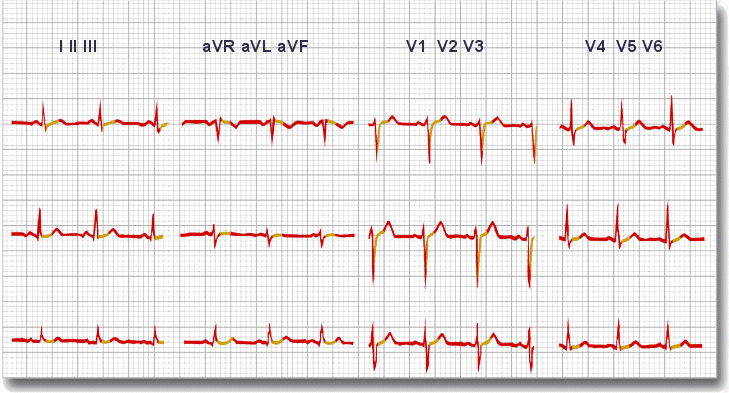
Como todos sabemos ( estudiantes de medicina humana) el tener que aprender a leer un EKG puede ser una experiencia muy dificultosa para muchos así que para poder aprender a leer correctamente y reconocer sus patologías primero tenemos que saber lo normal así que aquí dejo las 10 reglas de Chamberlain para poder saber cuando un EKG es normal y así desde ahí poder saber reconocer cualquier patología.
Regla 1: El intervalo PR debe ser de 120 a 200 milisegundos o de 3 a 5 pequeños cuadrados
Regla 2: La anchura del complejo QRS no debe exceder 110 ms, menos de 3 pequeños cuadrados
Regla 3:La anchura del complejo QRS no debe exceder 110 ms, menos de 3 pequeños cuadrados
Regla 4: Las ondas QRS y T tienden a tener la misma dirección general en las derivaciones de las extremidades
Regla 5:Todas las ondas son negativas en plomo aVR
Regla 6:
La onda R en las derivaciones precordiales debe crecer de V1 a por lo menos V4
La onda S en las derivaciones precordiales debe crecer desde V1 hasta al menos V3 y desaparecer en V6.
Regla 7:El segmento ST debe comenzar isoeléctrico excepto en V1 y V2 donde puede ser elevado
Regla 8: :Las ondas P deben estar erguidas en I, II y V2 a V6
Regla 9: No debe haber una onda Q o sólo una pequeña q menor de 0.04 segundos de ancho en I, II, V2 a V6
Regla 10: La onda T debe estar en posición vertical en I, II, V2 a V6
Aquí les dejo un video donde se ve como se lee muy xvr.